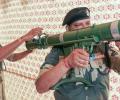
The Border Security Force (BSF) is raising a maiden 'drone squadron' for deployment along the India-Pakistan border. The squadron will comprise reconnaissance, surveillance and attack drones and specially-trained personnel.

The Shree Jagannath Temple Managing Committee (SJTMC) has formed a sub-committee, headed by former Lt Governor of Jammu and Kashmir, Girish Chandra Murmu, to suggest measures to ensure full protection of the temple in light of recent security breaches.

'If they can be duplicitous, we can be equally duplicitous.' 'If they offer friendship, we reciprocate.' 'If they choose hostility, we respond with equal hostility.'
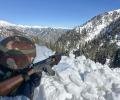
The exchange of fire occurred even though the directors general of military operations of India and Pakistan spoke over the hotline on Tuesday amid rising tensions between the two countries over the Pahalgam terror attack on April 22.
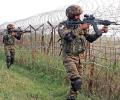
Pakistan troops have violated the ceasefire agreement for the 11th consecutive night, firing on Indian posts along the Line of Control (LoC) in Jammu and Kashmir. The firing began in Kupwara and Baramulla districts and spread to other sectors, including Poonch, Rajouri, Mendhar, Naushera, Sunderbani, and Akhnoor. The Indian Army responded promptly and proportionately. The ceasefire violation comes despite a recent phone call between the Directors General of Military Operations (DGMOs) of India and Pakistan on April 29. This marks the latest escalation of tensions between the two countries, following a terror attack in Pahalgam in April.
A cold wave has intensified in most parts of north India, with temperatures in the Kashmir Valley dipping below freezing point. The national capital saw a brief respite from the bitter cold during the day, but cold conditions persisted in parts of Rajasthan and Himachal Pradesh. The weather department has issued a yellow warning for cold wave, ground frost and dense fog for some places in Himachal Pradesh. There is a possibility of rain and snowfall in parts of northwest India later in the week.
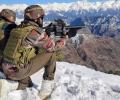
Pakistan's troops have engaged in unprovoked firing along the Line of Control (LoC) and International Border (IB) in five districts of Jammu and Kashmir, prompting retaliation from the Indian Army. This marks the eighth consecutive night of such incidents, following heightened tensions stemming from a recent terror attack in Pahalgam. Civilians residing along the LoC and IB are preparing their bunkers in anticipation of potential escalation.

For the ninth consecutive night, Indian and Pakistani troops engaged in small arms fire along the Line of Control (LoC) in Jammu and Kashmir, continuing a pattern of heightened border tensions. The skirmishes, initiated by Pakistani troops in violation of the ceasefire agreement, have led to a tense situation along the LoC and International Border (IB). The incidents come in the wake of the April 22 terror attack in Pahalgam, which claimed the lives of 26 people, mostly tourists. Civilians residing near the border have begun preparing their bunkers, anticipating potential escalation. Despite a recent hotline conversation between the Directors General of Military Operations (DGMOs) of India and Pakistan, where India cautioned Pakistan, the ceasefire violations persist.

Jammu and Kashmir Chief Minister Omar Abdullah has stated that the conversation regarding the restoration of statehood to Jammu and Kashmir has not been stalled. He claims the issue was raised at the recent NITI Aayog governing council meeting, and the formal speech distributed at the meeting includes a mention of the return of statehood. Abdullah also addressed concerns about the impact of the Pahalgam terror attack on tourism, emphasizing the importance of local Kashmiris visiting tourist spots first to revive the industry and ensure a sense of security.

A UN Security Council report states that The Resistance Front (TRF) claimed responsibility for the Pahalgam terror attack and published a photograph of the attack site. The report also cites assertions that the attack could not have happened without the support of Pakistan-based Lashkar-e-Tayyiba (LeT).

In a post on X, the additional directorate general of public information posted: "Pakistan again violates the Ceasefire Agreement by firing artillery in Bhimber Gali in the Poonch-Rajouri area. Indian Army is responding appropriately in a calibrated manner."
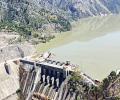
India has stopped releasing water from the Baglihar Dam on the Chenab River and is planning similar measures at the Kishanganga Dam on the Jhelum River, following a recent terror attack in Jammu and Kashmir. These hydroelectric dams offer India the ability to regulate water releases. This decision potentially affects the Indus Waters Treaty, a decades-old agreement between India and Pakistan governing the use of the Indus River and its tributaries. The Baglihar and Kishanganga dams have been points of contention between the two nations in the past.

A woman was killed and two of her family members injured after Pakistani troops resorted to heavy shelling in areas near the Line of Control (LoC) in Uri sector of Jammu and Kashmir. The Indian Army retaliated to the Pakistani aggression. Pakistani troops violated the ceasefire along the LoC and targeted civilian areas in Uri sector of north Kashmir's Baramulla district, causing damage to structures and forcing people to flee. The injured were rushed to a hospital where a woman, identified as Nargis Begum, succumbed to injuries.
The Indian Army responded in a measured and effective manner to the provocation.

New Delhi looks to be testing Omar's endurance with unconcealed glee, never feeling shy to bite whenever a moment comes its way. After all, ruling the country's only Muslim-majority UT/state has been the BJP's burning desire, points out Mohammad Sayeed Malik, the distinguished commentator on Kashmir affairs.

The Indus Waters Treaty, brokered by the World Bank, has governed the use of the Indus River and its tributaries between India and Pakistan since 1960.
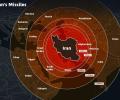
The Israel Defence Forces (IDF) on Saturday issued a new graphic showing Kashmir as Indian territory, rectifying their previous mistake.

Two terrorists were killed on Wednesday as an infiltration bid was foiled along the Line of Control in Jammu and Kashmir's Baramulla district, officials said. The Army said the infiltration bid was foiled in Uri Nala of the north Kashmir district. The troops on the LoC challenged and intercepted the infiltrators, resulting in a "heavy" firefight, the army said. Large quantity of weapons, ammunition and other war-like stores have been recovered from the terrorists, it said, adding, the operation is in progress.

A series of blasts took place in Srinagar city as the security agencies brought down a drone that was seen hovering over Batwara area of the city, close to an army installation, officials said.
Pakistani troops continued unprovoked small arms firing in different sectors along the Line of Control (LoC) in Jammu and Kashmir for the 10th consecutive night, prompting effective retaliation by the Indian army. The ceasefire violations, which started after the April 22 terror attack in Pahalgam, were reported from eight places across five districts in the Union Territory during the intervening night of Saturday and Sunday. Indian Army responded promptly and proportionately to the unprovoked firing, a defence spokesperson said.

Security agencies have gathered evidence, including Pakistani government documents and biometric data, confirming that the terrorists involved in the Pahalgam attack were Pakistani nationals.
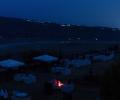
Meanwhile, a precautionary blackout has been enforfced in the multiple areas amid the esclating tensions between India and Pakistan.

The epicentre was located 60 kilometres northwest of Rawalpindi, according to the National Seismic Monitoring Centre (NSMC).

On Wednesday, April 9, 2025, the Indian Army's Chinar Warriors and the Jammu and Kashmir police recovered and destroyed an IED on the Wadder-Haphruda road at Haphruda village in Kupwara, north Kashmir.

Abdullah, who visited the shelling-affected areas of Uri, including Salamabad, Lagama, Bandi and Gingal in north Kashmir's Baramulla district, also said that he would take up the demand for building individual bunkers in these areas with the Centre.

Modi will start his visit on June 6 by dedicating to public the Chenab rail bridge, which is a key part of the 272-km Udhampur-Srinagar-Baramulla railway link (USBRL) that will provide direct train connectivity to the valley.

PBKS-DC game also uncertain, say BCCI Sources

Sinha said the inauguration of the Kashmir rail service has connected the hearts of the people of Jammu and Kashmir with the rest of the country and will pave the way for the economic prosperity of the region.
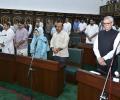
The Jammu and Kashmir assembly unanimously passed a resolution on Monday expressing shock and anguish over the terrorist attack in Pahalgam and resolved to fight resolutely to defeat the nefarious designs to disturb communal harmony and hinder progress.
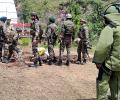
The officials said dozens of unexploded explosives were destroyed by the experts along the Line of Control in Rajouri and Poonch districts and along the International Border in Jammu and Samba which witnessed intense cross-border shelling and drone attacks from May 7 to May 10.

The worst-hit in the Pakistani shelling was Poonch district which accounted for all the civilian deaths, the officials said, adding 28 persons were also injured and the condition of some of them was stated to be critical.
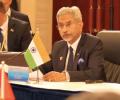
Jaishankar said the UN Security Council condemned the attack and underlined the need to hold perpetrators, organisers, financiers and sponsors of the reprehensible act and bring them to justice.
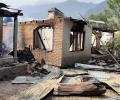
Hundreds of residents along the Line of Control (LoC) and the International Border (IB) in Jammu and Kashmir were evacuated to safer zones after Pakistani shelling following Indian airstrikes on terror targets in Pakistan. The shelling killed 12 people, including four children and two women, and injured over 50. The evacuations come amid heightened tensions between India and Pakistan following the April 22 terror attack in Pahalgam that left 26 civilians dead. The government has provided temporary shelter for those evacuated.
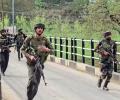
"More than 85,000 domiciles have been issued to non-locals, creating a pathway for demographic change in Jammu & Kashmir. These non-locals arrive posing as tourists, obtain domiciles, and then begin to act as if they own the land. Consequently, violence will be directed toward those attempting to settle illegally," TRF said in a statement which could not be independently verified by Rediff.
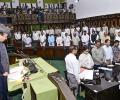
The Jammu and Kashmir Assembly unanimously passed a resolution on Monday expressing shock and anguish over the Pahalgam terrorist attack and resolved to fight resolutely to defeat the nefarious designs to disturb communal harmony and hinder progress.

Congress rebel Satish Sharma, who defeated the Bharatiya Janata Party's Rajeev Sharma by nearly 7,000 votes and relegated his former party's heavyweight Tara Chand to the third position in the Chhamb seat, has found a place in the Omar Abdullah government, representing the Jammu region in the dispensation.

Days after the Pahalgam terror attack, Jammu and Kashmir authorities have deported 59 Pakistani nationals, including the mother of Shaurya Chakra awardee Constable Mudasir Ahmad Sheikh. The Pakistani nationals were living in the valley for decades and were transported to Punjab for repatriation. However, the mother of the deceased soldier was later allowed to stay back. The deportation comes after the Indian government announced a slew of measures against Pakistan in the wake of the Pahalgam attack, including the suspension of the Indus Waters Treaty and the downgrading of diplomatic relations.

The squad announcement also marks the return of East Bengal's dependable central defender Anwar Ali, who had been sidelined since February due to a hamstring injury. He last featured in competitive action against Bengaluru FC in the ISL.
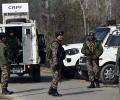
The Special Investigation Agency (SIA) has arrested two more persons, including a policeman, for allegedly being part of a cross-border narcotic syndicate involved in terror funding in Jammu, officials said on Wednesday.
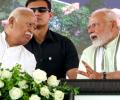
BJP and RSS leaders are once again pushing to remove the words 'secular' and 'socialist' from the Constitution's Preamble, showing a deeper effort to change India's identity from a diverse, multi-religious republic to a Hindu-first nation, even though they don't have the numbers in Parliament to officially change the Constitution, observes N Sathiya Moorthy.
 © 2026 Rediff.com - Advertise with us - Disclaimer - Privacy Policy - Sitemap - Feedback - About us - Terms of use - Grievances